
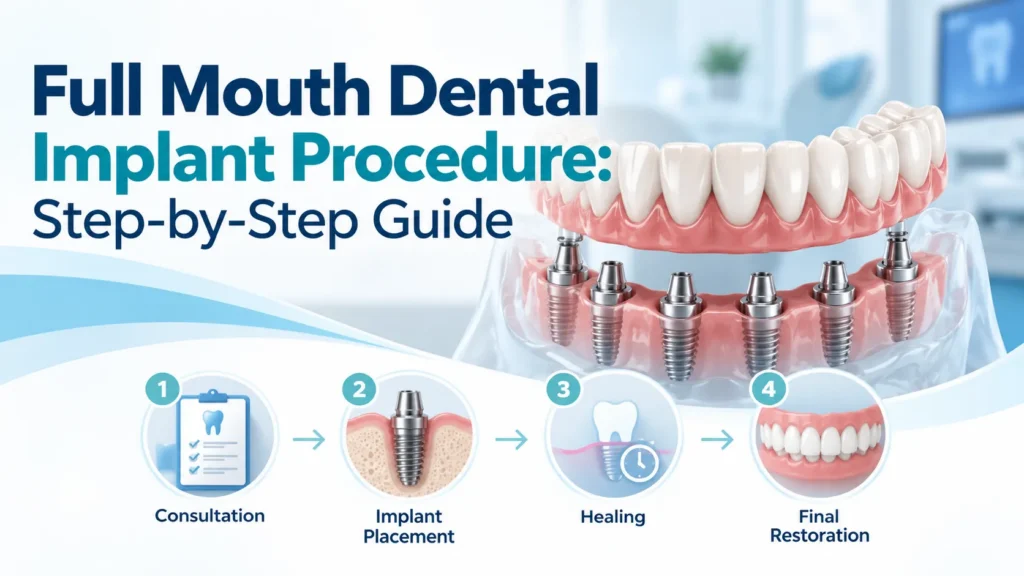
Full-mouth dental implant treatment involves several stages, including dental examinations, treatment planning, implant placement, healing, and attaching the final replacement teeth. The process replaces an entire upper or lower arch of missing teeth using several implants to support a full-arch restoration.
Unlike a single dental implant, which typically replaces one tooth, full-mouth treatment uses multiple strategically positioned implants to support a complete set of replacement teeth.
The exact steps and treatment timeline depend on the patient’s oral health, jawbone condition, and restoration type. Understanding each stage can help patients know what to expect before, during, and after treatment.
What Happens During the Full Mouth Dental Implant Process?
The full mouth dental implant procedure usually follows five main stages:
- Initial consultation and oral examination
- Treatment planning and preparation
- Surgical placement of dental implants
- Healing and implant integration
- Final restoration and follow-up care
Some patients also receive temporary teeth during treatment. The timing depends on implant stability, oral health, and the dentist’s clinical assessment.
Step 1: Initial Consultation and Dental Examination
The first stage is a comprehensive dental examination. The dentist assesses the patient’s teeth, gums, jawbone, and bite to determine whether full-mouth implant treatment is appropriate.
The consultation may include a review of:
- Existing teeth: Checking for missing, damaged, infected, or potentially restorable teeth.
- Gum health: Identifying periodontal disease or inflammation that may need treatment.
- Jawbone condition: Assessing whether sufficient bone is available to support implants.
- Medical history: Reviewing health conditions, medications, and factors that could affect surgery or healing.
- Bite and jaw function: Evaluating how the upper and lower teeth come together.
The dentist also discusses the patient’s expectations and explains which diagnostic tests may be necessary.
This stage helps identify potential complications before surgical treatment begins.
Step 2: 3D Imaging and Treatment Planning
After the initial examination, the dental team develops an individualized treatment plan.
Dental X-rays and, when appropriate, cone-beam computed tomography (CBCT) scans provide information about the jawbone and nearby anatomical structures.
These images help the dentist assess implant positions and identify structures that must be considered during surgery.
What Does the Dentist Plan?
Treatment planning generally addresses:
- The number of implants required
- Implant positions and available bone
- Whether any existing teeth need extraction
- Whether bone grafting or other preparation is necessary
- The type of full-arch restoration
- The expected sequence of procedures
- Whether temporary teeth may be provided
The proposed restoration influences implant planning. Implant positions must provide appropriate support for the replacement teeth, not just fit within available bone. For some patients, All-on-X dental implants may be considered as part of a full-arch treatment plan, depending on available bone and restorative needs.
A clear treatment plan also helps patients understand the procedures that may be required before their final teeth are placed.
Step 3: Preparing the Mouth for Implant Placement
Not every patient can proceed directly to implant surgery.
Some require preliminary dental treatment to improve oral health or create suitable conditions for implant placement.
Tooth Extractions
If teeth are severely damaged or cannot be predictably restored, extraction may be recommended.
However, full-mouth treatment does not automatically mean every remaining natural tooth must be removed. Each tooth should be evaluated before extraction decisions are made.
Depending on the treatment plan, implants may sometimes be placed during the same appointment as extractions. Other cases require a healing period first.
Gum Disease Treatment
Active gum disease or infection may need to be addressed before implant placement.
Healthy surrounding tissues and consistent oral hygiene support the long-term health of implant-supported restorations.
Bone Grafting
Some patients have insufficient jawbone where implants need to be placed.
Bone grafting may help rebuild or preserve bone, although it is not required for every patient.
If grafting is necessary, additional healing time may be needed before implant placement.
The preparation stage varies considerably. Your dental team should explain which procedures are necessary and why.
Step 4: Surgical Placement of Dental Implants
During implant surgery, the dentist or oral surgeon places dental implants into planned positions within the jawbone.
Dental implants are typically titanium or another approved implant material designed to support dental restorations.
The procedure is generally performed using local anesthesia. Sedation may also be offered when appropriate, based on the patient’s health and treatment needs.
What Happens During Surgery?
The surgical process generally involves:
- Administering anesthesia to numb the treatment area.
- Accessing the jawbone at the planned implant sites.
- Preparing each implant site using the appropriate surgical instruments.
- Positioning the dental implants within the bone.
- Placing healing components or closing the surgical sites as required.
The precise technique depends on implant design, bone condition, and the surgical plan.
A full-arch restoration typically requires several implants rather than a separate implant for every missing tooth.
Will You Feel Pain During Implant Surgery?
Local anesthesia is intended to prevent pain during the procedure, although patients may still notice pressure or vibration.
After the anesthesia wears off, temporary discomfort, swelling, or bruising may occur.
Your dental team should provide instructions for managing postoperative symptoms and explain which signs require urgent attention.
Step 5: Temporary Teeth After Implant Placement
Some full-mouth implant patients receive temporary replacement teeth shortly after surgery.
This approach may be considered when the implants achieve sufficient initial stability and the clinical conditions support early loading.
However, same-day temporary teeth are not appropriate for every patient.
Others may need to wait while the surgical sites heal before an implant-supported temporary restoration is attached.
When used, temporary teeth help patients maintain appearance and some function during healing. They may also allow the dental team to assess aspects of the planned restoration.
Patients should follow any dietary restrictions their dentist provides, even if temporary teeth are attached soon after surgery.
Step 6: Healing and Osseointegration
After implant placement, the implants need to establish stable support within the jawbone.
This biological process is called osseointegration. It occurs as bone heals and establishes direct contact with the implant surface.
Healing is an important part of full-mouth dental implant treatment because the final restoration must be supported by implants that can withstand normal functional forces.
How Long Does Healing Take?
Healing timelines vary by patient and treatment plan. Osseointegration often takes several months, but restoration timing depends on more than elapsed time alone.
Factors that may affect healing include:
- Bone quality and quantity
- Implant stability at placement
- Whether grafting or extractions were performed
- Overall health and medications
- Smoking or tobacco exposure
- Healing response and oral hygiene
- The planned loading protocol
Regular follow-up appointments allow the dental team to evaluate healing and determine when the implants are ready for the next stage.
What Should Patients Do During Healing?
Patients should follow their dental team’s postoperative instructions.
These may include maintaining oral hygiene around the surgical area, eating recommended foods, taking prescribed medication correctly, and attending follow-up appointments.
Contact your dental provider if you develop worsening pain, persistent bleeding, unusual swelling, fever, or other concerning symptoms.
Step 7: Designing and Placing the Final Teeth
Once the implants are ready for the final restoration, the dental team completes the prosthetic design.
For patients considering full mouth dental implants in Tucson, the final restoration is designed around their bite, appearance, comfort, and long-term functional needs.
The restoration may be a fixed implant-supported bridge or a removable implant-supported denture, depending on the original treatment plan.
How Are the Final Teeth Designed?
The dentist evaluates several factors, including:
- Tooth position and appearance
- Bite alignment
- Speech
- Chewing function
- Gum contours
- Cleaning access
- Comfort and fit
Digital scans, impressions, bite records, and trial restorations may be used to prepare the final prosthesis.
Attaching the Final Restoration
The final replacement teeth are connected to the implants through appropriate restorative components.
The dentist checks the fit and bite and makes necessary adjustments.
Patients also receive instructions for cleaning their specific restoration and recognizing problems that require professional assessment.
Completing this stage marks the end of the main restorative treatment, but not the end of implant maintenance.
Full Mouth Dental Implant Treatment Timeline
The overall timeline depends on the procedures required and the patient’s healing response.
| Treatment Stage | What to Expect |
| Consultation | Oral examination, medical history review, and discussion of treatment options |
| Imaging and planning | Assessment of jawbone anatomy and implant positions |
| Preparation | Extractions, infection management, or grafting if needed |
| Implant surgery | Surgical placement of the implants |
| Temporary restoration | May be provided when clinically appropriate |
| Healing | Tissue healing and osseointegration, often over several months |
| Final restoration | Fitting and attaching the definitive replacement teeth |
| Follow-up care | Monitoring implant health, restoration fit, and oral hygiene |
Some stages may be completed together, while others require separate appointments or healing periods.
For this reason, patients should request an individualized timeline rather than assume everyone completes treatment in the same number of visits.
What Happens After the Final Restoration?
Full-mouth implants require ongoing care, even after the replacement teeth have been fitted.
The implants do not develop tooth decay, but the surrounding gums and bone can become inflamed or diseased.
Implant-supported bridges and dentures may also experience wear or require repairs and adjustments.
Regular maintenance generally involves daily cleaning, professional examinations, and monitoring of the implants and prosthetic components.
Your dentist may recommend specialized brushes, flossing tools, or other cleaning devices depending on your restoration design.
Following a consistent maintenance routine helps protect the implants and allows potential complications to be identified early.
Conclusion
The full mouth dental implant treatment process begins with a detailed examination and continues through planning, preparation, implant surgery, healing, and final restoration.
Some patients require additional procedures or longer healing periods, while others may be suitable for an earlier temporary restoration.
Understanding these stages helps patients prepare for treatment, follow postoperative instructions, and maintain their implant-supported teeth after the final restoration is placed.
Frequently Asked Questions
How Many Steps Are Involved in Full Mouth Dental Implant Treatment?
The main stages are consultation, imaging and planning, preparation if needed, implant surgery, healing, final restoration, and follow-up care. The number of appointments varies with the treatment plan.
Are Full Mouth Dental Implants Placed in One Day?
Depending on the case, implants may be placed during a single surgical appointment. Some patients may also receive temporary teeth that day. However, biological healing and completion of the definitive restoration generally require additional time.
Do You Need Bone Grafting Before Full Mouth Implants?
Not necessarily. Bone grafting is recommended only when the clinical assessment indicates that additional bone support is needed for the proposed treatment.
How Long Does It Take for Full Mouth Implants to Heal?
Implant integration often takes several months. The exact healing period depends on bone condition, implant stability, general health, and any additional procedures.
Can You Eat Normally After Full Mouth Implant Surgery?
Patients usually need to follow a modified diet during early healing. The recommended foods and timing for returning to firmer foods depend on the surgical procedure and restoration. Follow your dentist’s specific instructions.